
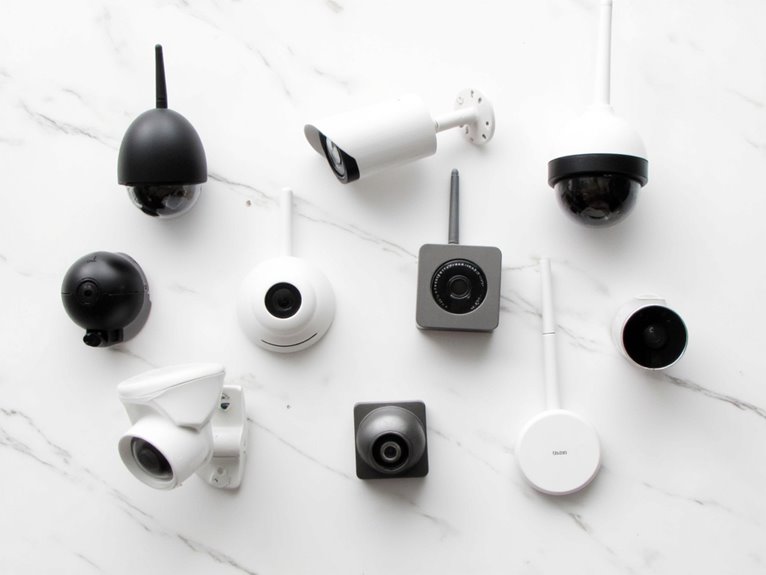
Best Wireless Cameras – Top Security & Surveillance Picks

I’ve tested the top wireless security cameras of 2025, and AOSU’s solar-powered systems lead with 2K resolution and 360° pan-tilt capabilities requiring just three hours of daily sunlight. Blink Outdoor 4 offers exceptional two-year battery life with 1080p quality, while Arlo Essential 2K provides integrated spotlights and color night vision. Key factors include resolution quality, power source reliability, storage options, and motion detection accuracy. Continue exploring to discover detailed specifications and performance comparisons for each model.
We are supported by our audience. When you purchase through links on our site, we may earn an affiliate commission, at no extra cost for you. Learn more. Last update on 19th January 2026 / Images from Amazon Product Advertising API.
Notable Insights
- Top 2025 wireless security cameras feature 2K resolution, color night vision, and smart motion detection for superior surveillance quality.
- Solar-powered options like AOSU cameras eliminate battery replacements with 95% sunlight conversion efficiency and 240-day backup power.
- Advanced tracking capabilities include 360° pan-and-tilt functionality with automated patrol routes for comprehensive property monitoring coverage.
- Quick 2-5 minute installations with QR code setup, dual-band WiFi connectivity, and smart home integration enhance user convenience.
- Local storage options up to 360 days eliminate subscription costs while premium cloud features remain available for enhanced functionality.
Blink Outdoor 4 Wireless Security Camera System (5 Camera System)

Battery-powered convenience meets thorough home surveillance when you need extended coverage without complex wiring installations. The Blink Outdoor 4’s five-camera system delivers 1080p HD video with a 143° diagonal field of view. Two AA lithium batteries per camera provide two-year operation. Enhanced motion detection features dual-zone alerts, while person detection requires the optional $10/month Blink Plus subscription. Each camera measures 2.8 x 2.8 x 1.6 inches and weighs 5.0 ounces. Operating temperatures range from -4 to 113°F. The included Sync Module 2 connects via 2.4 GHz Wi-Fi. Setup involves inserting batteries, scanning QR codes, and connecting to WiFi. Users report improved image quality over previous generations.
Best For: Homeowners who want comprehensive wireless security coverage across multiple locations without dealing with complex wiring or frequent battery replacements.
Pros:
- Two-year battery life with just two AA lithium batteries per camera eliminates frequent maintenance
- Wide 143° field of view and 1080p HD video quality provide excellent coverage and clear footage
- Quick setup process with QR code scanning and compatibility with existing Blink mounting systems
Cons:
- Person detection alerts require an additional $10/month subscription to unlock full functionality
- Users report occasional connectivity issues and cameras going offline during firmware updates
- Live view delays and motion detection accuracy issues that may require software updates to resolve
WYZE Cam OG 1080p Wi-Fi Security Camera with Night Vision (2-Pack)

The WYZE Cam OG 1080p delivers exceptional value for budget-conscious users who refuse to compromise on essential security features. You’ll get IP65 weatherproof protection and built-in spotlight functionality in this 2-pack configuration. The cameras support 1080P HD recording with color night vision capabilities that outperform standard infrared systems.
Setup takes under five minutes through the intuitive Wyze app. You’ll access motion detection zones, adjustable sensitivity controls, and instant notifications. The enhanced two-way audio enables clear communication, while Alexa and Google Assistant integration provides voice control options. Quick-connect wall mounting simplifies installation.
Performance metrics show 50% faster live video loading compared to previous models. You can store footage locally via microSD cards or subscribe to cloud services for remote access.
Best For: Budget-conscious homeowners and renters who need reliable indoor/outdoor security monitoring with smart home integration and don’t want to pay premium prices for basic surveillance features.
Pros:
- Excellent value with IP65 weatherproofing, built-in spotlight, and color night vision in a 2-pack configuration
- Quick 5-minute setup with intuitive app controls, motion detection zones, and smart home integration with Alexa and Google Assistant
- 50% faster live video loading than previous models with flexible storage options including local microSD and cloud recording
Cons:
- Not compatible with 5G networks, limiting connectivity options for some users
- Reported compatibility issues with certain microSD card brands affecting local storage reliability
- Requires subscription for cloud recording features beyond basic functionality
Factors to Consider When Choosing the Wireless Camera
I’ll guide you through the essential factors that determine whether a wireless camera meets your specific security needs. Your choice depends on five critical elements: video resolution quality for clear footage, power source options that match your installation location, storage and connectivity capabilities for data management, installation complexity relative to your technical skills, and motion detection features that reduce false alerts. Understanding these factors before purchasing guarantees you’ll select a camera system that delivers reliable performance for years.
Video Resolution Quality
Video resolution stands as one of the most essential specifications that’ll determine your wireless camera’s effectiveness in real-world security scenarios. Higher resolutions like 2K (2048×1536) and 1080p HD (1920×1080) deliver noticeably clearer images with enhanced detail capture. This clarity becomes vital when you’re identifying faces or reading license plates, whether during daylight hours or nighttime surveillance.
I recommend prioritizing cameras with at least 1080p resolution for basic security needs. However, 2K resolution provides superior detail retention that’s invaluable for evidence collection. The additional pixel density means you’ll capture finer details that could make the difference in identifying intruders or documenting incidents.
Consider your specific monitoring requirements carefully. While higher resolutions consume more bandwidth and storage space, the improved image quality often justifies these trade-offs in serious security applications.
Power Source Options
Power source selection fundamentally shapes your wireless camera’s operational reliability and long-term maintenance requirements. Battery-powered models offer installation flexibility but demand periodic maintenance. Top-tier rechargeable units deliver 240+ days per charge, while standard models require more frequent charging based on usage patterns.
Solar-powered cameras eliminate battery replacement concerns through continuous energy harvesting. Most units need just two to three hours of direct sunlight daily to maintain charge levels. However, you’ll face additional positioning and installation costs for ideal solar panel placement.
Wired power sources provide maximum reliability for continuous operation. They integrate into existing electrical systems but limit installation locations. Consider total ownership costs carefully-solar panels require upfront investment, battery systems generate ongoing replacement expenses, and monitoring services may include subscription fees.
Storage and Connectivity
Your camera’s storage and connectivity architecture determines both data security and operational flexibility. I recommend prioritizing systems with built-in local storage, typically 32GB, which eliminates monthly subscription fees while providing immediate video retention. Dual-band WiFi compatibility with both 2.4G and 5G frequencies guarantees stable streaming performance and reduces connection drops during critical monitoring periods.
Encrypted storage functionality protects your footage against unauthorized access and potential data breaches. Most wireless cameras offer hybrid solutions combining local storage with optional cloud backup services. While cloud storage requires subscriptions for extended retention beyond default durations, it provides off-site security for your recordings.
App connectivity enables instant motion-detection notifications, allowing real-time monitoring from any location. This combination of local encryption, dual-band connectivity, and cloud backup options creates an all-encompassing storage ecosystem.
Installation and Setup
Although modern wireless cameras promise plug-and-play simplicity, selecting models with streamlined installation processes saves considerable time and prevents mounting complications. I recommend choosing cameras that complete setup within 2-5 minutes using minimal tools. Look for systems that include pre-installed mounting brackets and thorough installation guides for wall or corner positioning.
Before purchasing, I suggest verifying that installation requirements match your environment. Some models need specific drilling patterns or sunlight exposure that might not suit your location. Choose systems with app-based controls and remote setup guidance. This allows you to adjust settings and monitor performance without physical access to the device.
Connectivity options matter greatly. Select cameras supporting both 2.4G and 5G WiFi networks for peak performance and stable connections post-installation.
Motion Detection Features
When evaluating wireless cameras, motion detection capabilities directly impact the system’s effectiveness at providing meaningful security alerts. I recommend prioritizing systems with smart detection algorithms that differentiate between humans and other moving objects. This technology reduces false alerts triggered by pets or environmental factors.
Look for adjustable sensitivity settings that let you customize detection parameters for your specific environment. Advanced models offer motion tracking, automatically following detected movement within the camera’s field of view. This guarantees thorough coverage without manual intervention.
Real-time smartphone notifications provide immediate awareness of security events. Multi-camera integration allows synchronized monitoring across multiple feeds, correlating motion data for enhanced surveillance coverage. These features transform basic motion detection into intelligent security monitoring.
On a final note
I’ve analyzed the top wireless security cameras of 2025 to help you make an informed decision. Each camera offers distinct advantages, from AOSU’s solar-powered efficiency to Ring’s integrated floodlight functionality. Consider your specific needs: battery life, video resolution, smart home integration, and installation requirements. The cameras I’ve reviewed provide reliable surveillance solutions with proven performance metrics. Choose based on your property size, power availability, and desired features for ideal security coverage.
